In the high-stakes world of digital marketing, "flexibility" is often sold as a premium service. Agencies frequently tout "unlimited revisions" as a badge of commitment, a promise that they will stay in the trenches until the work is "perfect."
But to a senior strategist, "unlimited revisions" is not a value proposition—it is a structural failure. It is a quiet, corrosive force that drains agency margins, destroys team morale, and, most importantly, dilutes the effectiveness of the client’s campaign.
What appears to be a safety net for the client is, in reality, a trap that leads to decision paralysis and operational rot. To understand why, we have to look past the spreadsheets and examine the behavioral psychology of the creative process and the brutal math of agency efficiency.
The Paradox of Choice and Decision Paralysis
The request for "just one more tweak" rarely stems from a strategic deficit. More often, it is a symptom of Analysis Paralysis.
When a client knows they have an infinite number of revisions, the stakes for any single decision vanish. Psychology tells us that when choices are reversible, we spend less effort making the right choice and more time second-guessing the one we made. This is the Endowment Effect in reverse: because the client doesn't "own" the finality of the version in front of them, they feel no urgency to commit.
In video production—specifically the high-velocity, 8-second formats currently dominating the market—this indecision is fatal. A "simple" change to a color grade or a half-second shift in a transition requires re-rendering, re-uploading, and re-reviewing. By the time "Version 12" is approved, the cultural moment the ad was designed to capture has often passed.
The Invisible Drain: Coordination Tax and Margin Erosion
Agency profitability isn't killed by big disasters; it’s bled dry by a thousand tiny adjustments. We call this the Coordination Tax.
Every revision request triggers a chain reaction:
-
The Account Manager must intake the feedback, clarify ambiguous terms (e.g., "make it pop"), and schedule a debrief.
-
The Creative Director must re-evaluate the strategy against the new changes.
-
The Editor or Designer must reopen the project files, execute the change, and export new versions.
-
The QA Team must ensure that the new tweak didn't break a different element of the asset.
When you offer unlimited revisions, you aren't just giving away "creative time"—you are burning project management hours that were never scoped. For a high-end agency, the margin lives in the delta between efficiency and expertise. Unlimited revisions move you out of the expertise business and into the "order-taking" business, where your hourly rate effectively plummets with every iteration.
The Myth of the "Perfect" Polish
There is a psychological threshold where further revision stops adding value and begins to strip it away. This is the Law of Diminishing Creative Returns.
In the era of static billboards, perfection was a requirement because the asset was permanent. In the era of algorithmic feeds, velocity is a higher virtue than polish. An 8-second video that is 80% "perfect" but launches on Monday will almost always outperform a 100% "perfect" video that launches three weeks later.
The "hidden cost" here is Opportunity Cost. While a team is hyper-focusing on the shade of blue in a background, they are not testing new hooks, analyzing audience data, or scaling winning sets. Excessive revisions keep the campaign in the lab when it should be in the market.
Separating Strategy from Execution
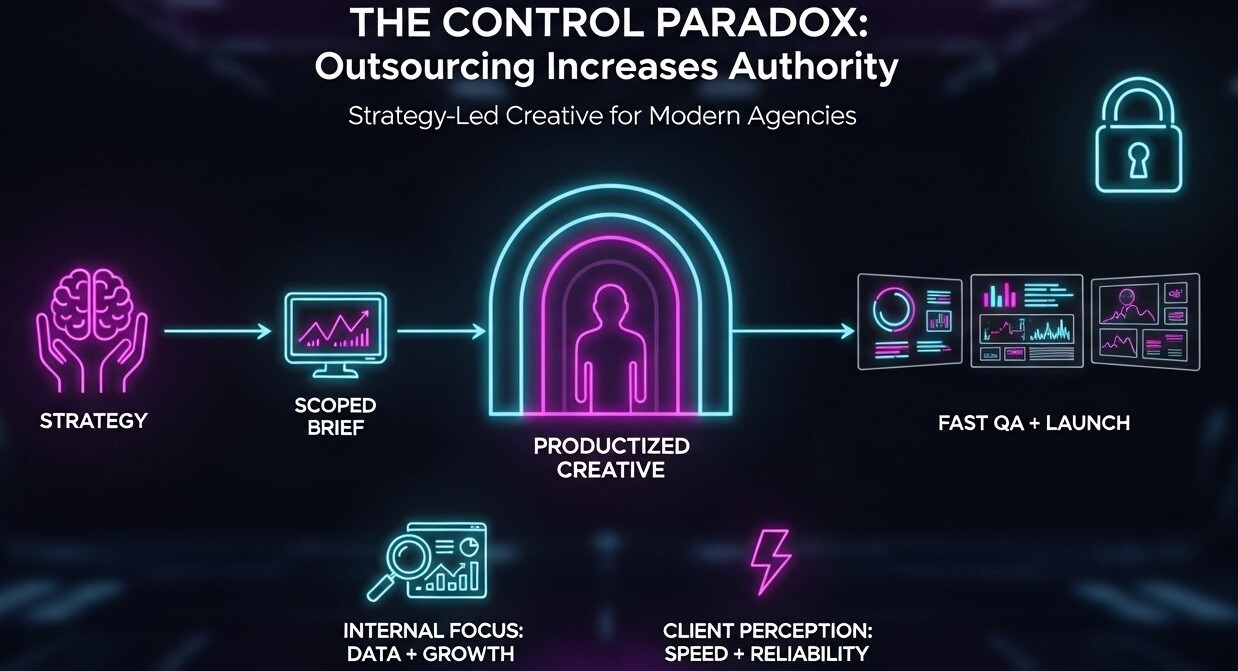
High-performing agencies solve this by creating a "firewall" between strategy and execution.
The strategy phase is where the "unlimited" thinking happens. This is the time for debate, exploration, and pivot. However, once the strategy is locked, the execution phase must be treated as a protected sprint.
| Feature |
Legacy Agency Model |
High-Performance Model |
| Revision Policy |
Reactive / Unlimited |
Proactive / Fixed (e.g., 2 rounds) |
| Stakeholder Input |
Constant and mid-stream |
Front-loaded and strategic |
| Creative Philosophy |
"Design by Committee" |
"Strategy-Led Execution" |
| Launch Velocity |
Slow (4–6 weeks) |
Fast (7–14 days) |
By enforcing clear creative constraints, you force the client to become a better partner. They are forced to consolidate their feedback and distinguish between "subjective preference" and "strategic necessity."
Accountability and the "Sunk Cost" Guardrail
Unlimited revisions actually diminish accountability on both sides.
-
For the Agency: If the team knows the client will likely change it anyway, they may not put their best thinking into Version 1.
-
For the Client: If they don't have to pay (in time or money) for a change of heart, they have no incentive to provide a quality brief.
Enforcing a "Two-Revision Limit" acts as a psychological guardrail. It signals to the client that the agency’s time is a finite, premium resource. It transforms the relationship from a vendor/customer dynamic into a partnership between two professional entities.
When the scope is fixed, the team stays focused. They know the finish line is visible. This clarity leads to higher-quality work because the energy is spent on creative problem solving rather than repetitive task execution.
The 8-Second Lesson: Why Speed Wins
As we pivot toward 8-second micro-videos, the "Revision Trap" becomes even more dangerous. Short-form video is a volume game. You need to be able to produce, test, and iterate based on market data, not boardroom opinions.
If your agency is bogged down in a three-week revision cycle for an 8-second asset, you cannot compete. The brands that win are those that move from "Idea" to "Live" in a matter of days. They treat their ads as experiments, not masterpieces.
Conclusion: Protecting the Work by Protecting the Process
The "Hidden Cost" of one more revision is ultimately the death of the campaign’s soul. Over-revised work is often sterile, safe, and boring. It has been sanded down by so many opinions that it no longer has the edges required to catch a consumer’s eye in a crowded feed.
To thrive, agencies must move away from the "Customer is Always Right" subservience of the past and toward a Consultative Authority. This means:
-
Fixed Scopes: Defining exactly what a "revision" is and where it ends.
-
Strategic Anchoring: Tying every creative decision back to the original, approved strategy.
-
Timeline Protection: Educating clients on how "one more tweak" directly correlates to a loss in ROI due to delayed launches.
When you protect the process, you protect the margin. And when the margin is protected, you have the resources to keep the best talent and deliver the best results.
At 8SecondStudio, we don’t just create content; we support agencies with fast, ad-ready short-form video execution — designed to plug into existing campaigns without friction. Click here to Get Started and see how our 8-second sprint methodology can transform your digital presence today.