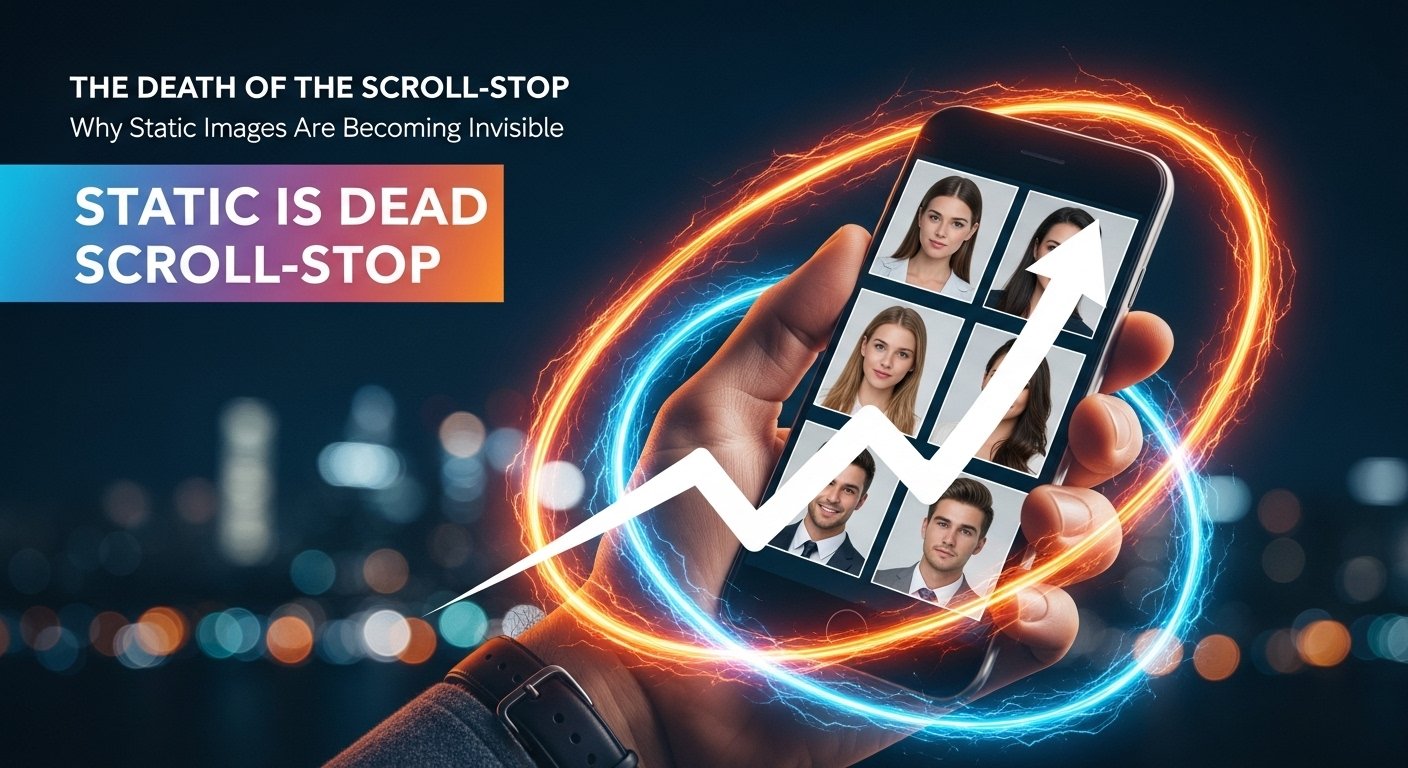
For years, the "scroll-stop" was the holy grail of digital advertising. The theory was simple: if you designed a static image with enough visual "pop," a bold enough font, or a striking enough color palette, you could physically stop a thumb in its tracks. But a fundamental shift has occurred in the way users interact with their feeds. Static ads aren’t failing because of bad kerning or poor color choices; they are failing because they have become part of the digital wallpaper.
We have entered an era of "banner blindness" on steroids. Modern consumers have developed a subconscious filter for static commercial content. Because a still image is passive, the brain can categorize and dismiss it in a fraction of a second without ever engaging the prefrontal cortex. To the modern user, a static ad is a hurdle to be cleared. To the platform, it is a low-energy signal. If you want to penetrate the noise, you can no longer rely on a static frame to demand attention—you must use motion to earn it.
The Psychology of the Micro-Moment
The shift toward 8-second video is rooted in behavioral psychology. The human eye is evolutionary hardwired to detect motion; it is a survival mechanism that predates marketing by millennia. In a digital environment, motion triggers an orienting response that a static image simply cannot replicate.
However, the "8-second window" is a specific constraint dictated by the "attention economy." We often hear the debunked statistic that humans have a shorter attention span than a goldfish, but the reality is more nuanced: we have an incredibly sophisticated relevance filter. We are willing to pay attention for long periods, but we decide whether to pay that attention in under two seconds. An 8-second video respects this filter. It provides enough time to deliver a sensory cue but is short enough that the "cost" of watching it feels negligible to the user.
Recognition vs. Storytelling
The biggest mistake brands make when moving to video is trying to tell a story. In an 8-second format, there is no room for a narrative arc, a protagonist, or a slow reveal. If you spend four seconds setting the scene, you have already lost.
These micro-videos are about recognition and relevance, not storytelling. The goal is to facilitate an "instant match" between the consumer’s current need and the brand’s solution.
Think of an 8-second video as a "digital billboard in motion" rather than a "mini-commercial." It is a high-frequency pulse designed to keep the brand top-of-mind, making it more effective for the high-volume, high-repetition nature of modern social feeds.
The Algorithm Advantage
Creative does not exist in a vacuum; it exists within an ecosystem governed by machine learning. Platforms like Meta, TikTok, and YouTube have moved toward a "video-first" architecture because video keeps users on the platform longer. Consequently, their auction algorithms are weighted to favor motion.
| Metric |
Static Ads |
Ultra-Short Video (6-8s) |
| User Engagement |
Passive (Low) |
Active (High) |
| Algorithm Preference |
Deprioritized |
Highly Favored |
| Attention Capture |
Relies on Contrast |
Relies on Neurological Trigger |
| Information Density |
Limited to 1 Frame |
High (Multiple Micro-Cues) |
| Testing Speed |
Slow Data Accumulation |
Rapid (High View-Through Rates) |
When you run an 8-second video, you aren't just appealing to the human; you are appealing to the math. High-completion rates on short videos signal to the algorithm that your content is "high quality," which can lead to lower CPMs (Cost Per Mille) and a broader reach compared to a static image that users quickly skip over.
The “Boutique Agency” Edge
Boutique agencies are leading the charge into the 8-second format because they operate with an agility that larger firms lack. Large-scale agencies are often bogged down by "The Big Idea"—a concept that requires a 30-second hero film, weeks of storyboarding, and massive production budgets. By the time that content is live, the market may have shifted.
Small, agile teams are using 8-second videos to implement Rapid Creative Testing (RCT). Instead of betting the entire quarterly budget on one "perfect" video, they produce five or ten variations of an 8-second clip.
-
Speed: You can refresh creative every week rather than every quarter.
-
Risk Mitigation: If a specific visual hook isn't working, you've only lost a few hours of production time, not a six-figure investment.
-
Data-Driven: Short videos provide cleaner data. If a user drops off at second 3 of an 8-second clip, you know exactly which visual element failed.
Actionable Strategy: Transitioning to Motion-First
Transitioning to a motion-first strategy does not require a Hollywood production crew. For many boutique firms, the most effective 8-second ads are "hybrid" creations.
-
Animate the Static: Take your best-performing static assets and add kinetic typography or a subtle "parallax" effect to the background.
-
The "Single-Message" Rule: One video, one message. If you are selling a "Divorce Law" service, the video should focus exclusively on one pain point—like "Protecting Your Assets"—rather than listing every service the firm offers.
-
Design for Mute: 80% of social video is consumed without sound. Your 8-second clip must be visually legible and use captions or text overlays to carry the weight.
-
The First 2 Seconds: If the most visually interesting thing happens at second 5, your video is 5 seconds too long. Start with the "payoff."
Conclusion: The Future of the Efficient Ad
The transition from static to 8-second video is a move toward efficiency. In a world of infinite content, attention is the scarcest resource. Static ads require a user to pause their behavior to process a message; 8-second videos integrate into that behavior by providing a quick, high-impact pulse of information.
As algorithms become more sophisticated and user patience continues to thin, the brands that win won't be the ones with the biggest stories to tell—they’ll be the ones who can prove their relevance in the time it takes to blink.
At 8SecondStudio, we don’t just create content; we support agencies with fast, ad-ready short-form video execution — designed to plug into existing campaigns without friction. Click here to Get Started and see how our 8-second sprint methodology can transform your digital presence today.